Indigenous History

Nolumbeka Project
The Nolumbeka Project, Inc. is a 501(c) (3) non-profit organization dedicated to the preservation of the history of Native Americans/American Indians of New England through educational programs, art, history, music, heritage seed preservation and cultural events. They are actively building, maintaining and expanding an historical archive research library for use by the Tribes and Educators of the Northeast and beyond.
The Board of Directors is comprised of volunteers who have been active for more than 40 years in a number of other preservation, historical research, environmental and social justice organizations.
Several of their Board members are of mixed Native American /American Indian heritage.
Visit the Nolumbeka Project website to learn more about their work, public events and volunteer opportunities.
Reconciliation Ceremony
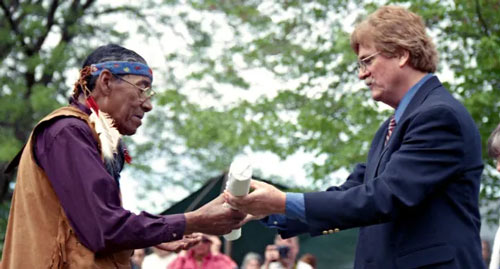
A Reconciliation Ceremony was held in Turners Falls, MA on the 328th Anniversary of the infamous Great Falls (Peskeompskut) Massacre led by Captain William Turner. In an effort to heal the wounds of the past, Montague Town Administrator Frank Abbondonzio asked Howard Clark and Joe Graveline of the now defunct Friends of Wissatinnewag to make the initial contact with tribal leaders. Clark and Graveline served as liaisons with members of the Narragansett Indian Tribe Historic Preservation Office (NITHPO). In a letter to medicine man Lloyd “Running Wolf” Wilcox, Abbondanzio wrote, “…(we) would like to sponsor a Native American Ceremony that would help our respective communities achieve a sense of healing for the tragic events that occurred at the Great Falls in 1676.
The Reconciliation Ceremony took place on the Connecticut Riverfront across from the massacre site just above the hydroelectric dam-once the site of the majestic fifty foot high Great Falls.
Lloyd “Running Wolf” Wilcox, the chief medicine man of the Narragansetts, officiated at the ritual, which included an ancient pipe ceremony and a ceremonial fire of birch bark and cedar bows. Anemone Mars, granddaughter of the tribe’s medicine woman, Ella Sekatau, gave the invocation, first in the Narragansett language, then in English. Following the ritual, gifts were presented to the Narragansetts, including tobacco grown in the Wissatinnewag garden.
Read the Reconciliation Agreement
Read The Invocation spoken by Anemone Mars
Day of Remembrance
Great Falls Discovery Center, Turners Falls
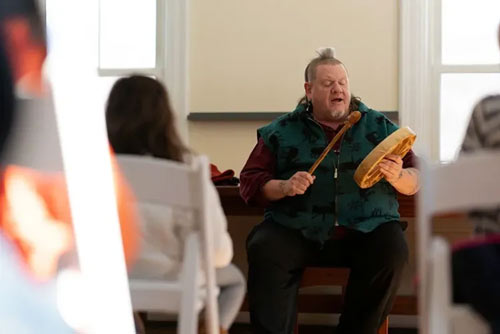
For thousands of years, Indigenous peoples from all around the Northeast gathered, fished and traded at Peskeompskut, now called Turners Falls. On May 19, 1676, over 300 Native people-mostly women, children and elders- were killed in an attack by armed English settlers at the Great Falls. This was among the largest massacres of Indigenous people in colonial U.S. history. During the Day of Remembrance Commemoration, native and non-native people gather together to honor and remember those who died in the massacre and to affirm Indigenous resilience. For event details visit the Nolumbeka Project website.

King Philip’s War Battlefield Project
Funded through the National Park Service Battlefield Protection Program
This unprecedented consortium of historic commissions, tribal historic preservation offices, town officials, scholars, and the National Park Service Battlefield Protection Program conducted a comprehensive study of the 1676 battle at Great Falls that was a turning point in the King Philip’s War.
Partnering organizations included the Towns of Montague, Gill, Greenfield and Deerfield, the Nolumbeka Project, the Mohegan Tribe, the Narragansett Tribe, the Nipmuc Nation, the Wampanoag Tribe of Gay Head/Aquinnah, the Mashpee Wampanoag Tribe, The University of Connecticut and The Mashantucket Pequot Museum and Research Center.
Walter Ramsey administered the grant for the Town of Montague. The results of this impressive undertaking includes technical reports in phases:
Technical Report: April 2016
Technical Report: January 2017
Technical Report: October 2020
Technical Report: September 2025
Visit the Town of Montague website for more information and additional documents.
Pocumtuck Homelands Festival
Unity Park Riverfront in Turners Falls
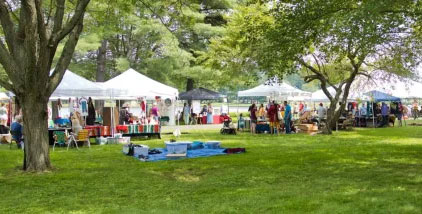
Started in 2014, this celebration of Native American art, music and cultures is an anticipated annual event. Named in honor of the Indigenous people that inhabited the territory of present-day Deerfield, Sunderland, Greenfield and Montague, The Pocumtuck Homelands Festival is an invitation to return to the fishing and trading shores of the Kwinitekw (Connecticut) River. Featuring a diverse marketplace of forty Indigenous craft vendors, outstanding history presentations, and traditional music and dance, the Pocumtuck Homelands Festival is fun and educational for all ages. This event is free, accessible, rain or shine. All talks and performances are sheltered.

Peskeompskut Audio Tour
A Self-Guided, QR code-Based Audio Tour
Canalside Rail trail, Turners Falls
The Peskeompskut Audio Tour explores the nuanced local history of Peskeompskut, an important Native American settlement sieged in 1676 during King Phillips War. The goal of this project is to ignite interest in Indigenous, Colonial and Industrial Era history and to honor the continuance the Nipmuc, Wampanoag and Abenaki people through the use of story.
This collection of personal, historic and interpretive narratives represents an arc of reconciliation efforts made between the Town of Montague and tribal representatives, starting in 2004. Story topics range from ancient Indigenous history to the 19th Century Industrial Era. Storytellers include David Brule, Rich Holshuh, Dr. David Naumec, Elizabeth "Coldwind" Santana-Kiser, Doug Harris, Robert Perry, Ed Gregory and Chris Clawson.
TO LISTEN:
You will need a QR scanner in your phone.
Begin the audio tour at the information kiosk located in the parking lot at the end of First Street. Background information about this project is posted, along with a QR code redirecting you to the SYQRY platform.
Scroll down and click “Start Tour.” You are now listening to Stop 1: Introduction. You can move through the following stops by clicking “next” or by scanning QR codes located on posts along the bike path walking toward the bridge.
You can also listen to the Peskeompskut Audio Trail here.
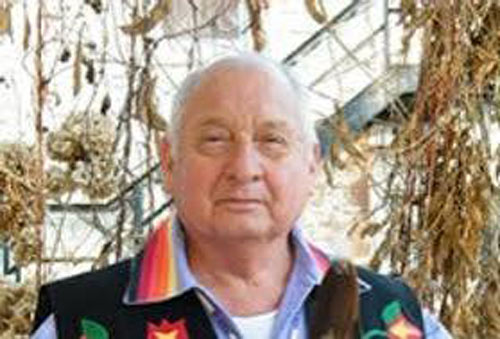
Tree Dedication Honoring Tom Porter, Mohawk Elder
On Friday, August 1, 2025, a White Pine Tree of Peace was dedicated on Connecticut Riverfront in Turners Falls. This gathering is given as an expression of deep gratitude and respect for Mohawk Elder Tom “Sakokweniokwas” Porter. Participating in the dedication were Akwesasne singer-songwriter Theresa Bear Fox, Native American Flute Player Mignon Geli, Councilor of the Chaubunagungamaug Band of Nipmuck Indians Jose “Ite” Santana, friends from the Leverett Peace Pagoda, and the public.
As part of Mohawk history, The Peacemaker came to them and four other nations in that region to bring the teachings of Peace to the minds and hearts of all the people and their leaders in times before colonization. They were times of great strife and violence, but the Peacemaker gradually convinced them that the ways of the Creator were the ways of Peace and Dialogue. White Pine Trees of Peace are planted as reminders to us and to generations to come.
Land Acknowledgement
We must acknowledge that we are standing on, and benefiting from land that has been seized, expropriated, and taken from Indigenous people, often through deceit, falsified deeds, and violence. For thousands of years this has been Pocumtuck land. This is still the homelands of the Pocumtuck, they are still here, their voices are still here in the air we breathe. These are still the homelands of the Pocumtuck, Norwottock, Woronoco, Agawam, Nipmuck, Abenaki. These Native peoples and their descendants are still living among us. They have not gone. Every time we gather here we must acknowledge and respect that fact.
But any land acknowledgement should also contain an acknowledgement of the land.
We have been taught by Indigenous elders that to draw our minds together at the beginning of any gathering we should remember to be grateful and thankful for all that we have been given:
- We give thanks to the sun every morning
- We give thanks to the four directions
- To all living creatures, they are our kinfolk and teachers
To the woodlands and rivers that sustain us:
- The Pocomegon (Green River),
- The Pocumpetuk (Deerfield River)
- The Roanasiatok (Fall River)
- The Paguag (Millers River)
- The mighty, long river Quonektakut
We give thanks to the hills and plains who are a part of us as we are of them-
- To the last 7 generations and the next 7 generations
- To our ancestors who have guided us and who are here with us now
We do not have to ask for anything. All this has been given to us.
Acknowledgement and expressing our thankfulness are the first steps in a long process of self-education. We must listen to Native voices who can remind us and teach us how to live in balance and reciprocity. We are all in this together. What will we do with what we have been given?
JOIN THE WEEKLY NEWSLETTER
We send out a list of events every week to help keep you informed.
SubscribeEXPLORE MONTAGUE, MA